Showing posts with label diurnal. Show all posts

Monday, November 21, 2011

Monastic Diurnal: Lancelot Andrewes -vs- St. Michaels Press


A reader writes:

I have a question about the Monastic Diurnal: Contents aside, which of the two editions out there is better quality as far as durability is concerned? (One thing that concerns me, for example, about the LA Press edition is its location of the Psalter - similar to the Anglican Breviary). I have read mixed reviews of both books on that subject and was wondering what your experience with each of them has been in that area. Thanks!

It is tough to discuss the two editions without touching on some of the content. There are folks out there that will purchase based on quality alone but be disappointed later on. I want them to have a better idea of what they might be purchasing but I'll try to keep it short.

Here are the two diurnals again, with a pen in front (my Red Pen of Doom, used to grade papers, mwuhaha) to give you some perspective on the size. The Lancelot Andrewes Press edition is noticeably thinner and slightly taller. However the thinness of the Andrewes edition means that it can easily fit in your back pocket. I have done this several times. Just try not to sit down on it because the cover takes a bit to get its shape back... The cover is the same material as the Anglican Breviary. It feels like a hard but flexible shell, not imitation leather.


I got my copy on eBay, so I don't know how long it has been in use. Nevertheless you can see here that because the Andrewes edition uses a stiff-shell material its end papers want to pull away from the cover . When this happens it reveals that the stiffness is not a result of undercover boards but the material itself. This is easy enough to glue for a quick fix. Yes it is a lesser quality than leather, but it adds to the durability because it isn't so delicate. This is a tough material.


Here we see the print in the Andrewes edition. The text is good size and bold. Keep in mind that both of these editions are reprints of revisions of books going back to the first half of the 20th Century. So the text formats in both represent that time period. Take a look at the collects here and you will three present for St. Luke. There is a fourth on the next page. This is pretty common and is done to accommodate Anglicans and Catholics of different stripes. The introduction to the book gives a good indication of how to tell the difference.


The Andrewes editions gives you the prayers before and after the Divine Office, as well as the Ave. Pater. Credo. previously said before each hour.


Here is the St. Michael's Abbey Press Monastic Diurnal. I bought mine some time ago. In fact is it one of the first books I ever mentioned on this blog. The cover is a flexible Moroccan Leather previously used by Baronius Press back in the day to clothe their Missals and Bibles. It is really nice and getting better with age. Hands down, this cover is more elegant than the Andrewes edition.   I tried to take a photo that would show you the quality, which I hope you can see. I hope they are still printing this book with the same material.


Here is the psalter. I like having the Latin and English. This is the Vulgate translation of the Psalms and a proprietary English. A benefit of this edition is that if you visit a traditional Benedictine monastery or convent then you can use this to participate. You can't do that with the Andrewes press, at least as a Catholic.  [I stand happily corrected!  Comment from Brian M:  Dear Matt, you may wish to note that the All Saints Sisters of the Poor, a former Anglican sisterhood in Catonsville, MD, which recently converted en masse to the Church and was established as a priory of Diocesan right, uses the Andrewes Press edition of the Diurnal for their daily office.] 


Here is the psalter, in the middle, where all breviary psalters should be placed.


Here is the Andrewes Press psalter placement. Up front. I find it a bit more confusing than the the St. Michael's edition. This photo also shows the shorter ribbons and the thinness of the cover material. I think the gilt edges are better on the Andrewes edition though.


The St. Michael's edition comes with cheater cards to help you find your way around the Office.


The Catholic St. Michael's edition has an updated table of moveable feasts until 2066.


I hope this helps. Quality wise I think this is a toss up. The Lancelot Andrewes edition is more of a workhorse. It is slightly more portable. Both versions have beautiful English. The Anglican one has the Coverdale Psalter. If it helps you to know which one I prefer, it is the Catholic St. Michael's Abbey edition because I appreciate having the Vulgate and English side by side.

Wednesday, December 16, 2009

By request: Diurnale Romanum by Preserving Christian Publications


Rich, in the comments, asked if I could show the Diurnale Romanum by Preserving Christian Publications. Here it is! Its true there aren't many photos out there on the different websites which carry it. In fact, on most sellers websites the photos for books are atrocious. There isn't much to review here. This is very straightforward.

I'll just mention a few things. First, even though this is advertised as having rounded corners and is even shown with rounded corners on some Catholic booksellers sites, the cover itself does not have them. It would be nice if it did, but no, they are square.

The text is bold typeface. A lot of ink was used in producing this. It provides for use in low light and I think cuts down in some of the loss occurring when printing the photocopy of the book. Nevertheless you may notice a few missing letters or half-letters in the book. (the errors are very sparse...) Overall this could pass for re-typset edition if you didn't look too closely.

There is artwork in this diurnal at the beginning of each section. It includes a bunch of extras for priests and laity. Overall, the Diurnale Romanum from PCP is a great budget breviary ($75 as compared to $300) for those comfortable with praying it entirely in Latin. There is no English in the book.


Binding is great. Not stiff in the least. Four ribbons and nice headbands.


Lays flat easily. Sewn hardbacks of good quality will do this.


Some of the artwork.


There is a bit of smudging around the edges. It looks like they may have cut a few corners (no pun intended) on the red dying of the edging.


Sorry of the cell phone picture. My camera battery died. In the front there are "card" pages sewn in with the repeated parts of the office. I like what they did with the Benedictus/Magnificat card. It is on the last page of the card section so it is easy to flip to.


A picture of the how the pages lay open. A little clumping. But this is forgivable.


Not a fan of the font on the spine. This picture shows its overall size. Phone looks good today, doesn't it?


Looks like PCP is temporarily out of stock in this title. You can find it on other sellers' websites. I know Aquinas and More has it, but the price is a little high.

Wednesday, April 30, 2008

Review: Monastic Matins - Lancelot Andrewes Press

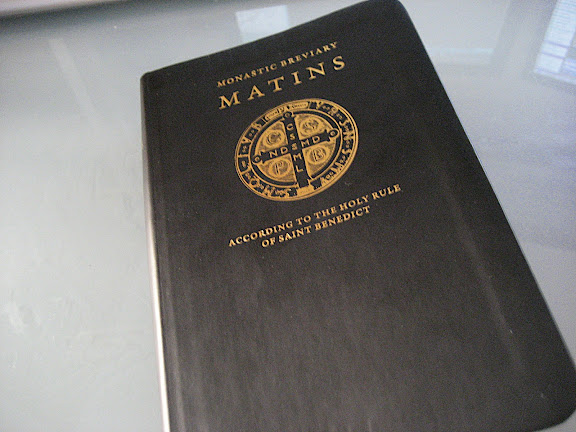
A picture of the Matins book.
Nice gold printing on the awesome Vivella cover.


I received a couple weeks ago my copy of Lancelot Andrewes Press edition of the Monastic Matins. This is essentially a photocopy/reprint of the 1925 Oxford Press edition with updates for the interim 1956 rubrics.

Here are a few more details:
  • The Psalter is the well known (Anglican) Coverdale version.
  • The rest of the scripture inside is King James aka Authorized Version.
  • The Collects are the English renditions from the Anglican Book of Common Prayer, though they correspond almost exactly to their "traditional" Catholic English renderings from my Baronius 1962 Missal and my explicitly Catholic Monastic Diurnal.
  • Being particularly Anglican, it includes and gives precedence to English Saints on the calendar. There are supplementals in the back for "Western Rite" feast days. These are for the Catholic and Western Rite Orthodox users of the book.
  • That means it does have the Assumption and other things with the Catholic Propers included...
I feel completely comfortable using this even though it is from a Western Rite Orthodox publisher. Praying the Monastic Breviary I have found is a very ecumenical affair. The online groups I belong to for this include Catholics, Orthodox, and Anglicans. All three denominations feel comfortable using the Diurnal/Matins from either St. Michael's Abbey (the one I use) or Lancelot Andrewes, which also has a corresponding Diurnal (sans Latin). It is all very much centered around the Benedictine Monastic Office. I find it kind of nice we can all rally around something.

Just to make the point clear, consider the publication of the Matins book:
  1. From a Catholic Breviary.
  2. Translated for use by Anglicans.
  3. Published by a Western Rite Orthodox publisher.
  4. Used lovingly by people of all three groups.
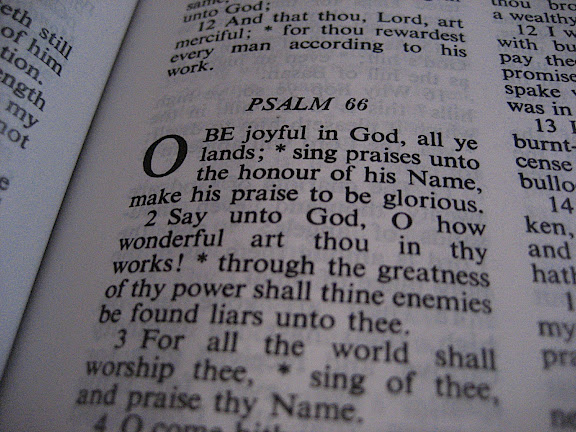
It is a nice thought anyway. Let's get back to the review. The paper is pretty nice ("Bible Paper"), though some of the print didn't come over very well. (Smudges, stuff like that. Very few, hardly noticeable. Trust me you won't mind.) The rubrics, ironically, are black and not red. Keeps costs down I assume. There are no ribbons but I learned from an Orthodox priest how to make my own, which turned out to be more fun than simply just having them.


The blurriness in the photo is a camera effect not a printing problem. 99% of the text is absolutely perfect, as you can see.


The real gem of this edition however is the cover. The cover is fantastic. Who the heck needs leather when you have Vivella? I once wrote that every book worth having was worth buying in leather. I need to modify that a little I think.

Any book worth having is worth buying in leather but buy it in Vivella if you can. Something like that. You get my point. Oh, btw, the price is right too. $45 ain't bad. Finally, if you have the Monastic Diurnal from St. Michael's, don't worry because this one supplements it just fine. At least it seems to in my humble estimation.

Wednesday, January 30, 2008

The Monastic Diurnal: Review


Last week I had the opportunity to purchase the Monastic Diurnal published by St. Michael's Abbey in Farnborough, UK. As I had posted on here before, the Liturgy of the Hours has become a part of my life through the well known Christian Prayer single volume.

If you are familiar with Baronius Press' leatherbound Missals and Bibles and are happy with them (as you should be) then you will also be happy with the Diurnal. The quality is exactly the same. In fact, I'm pretty sure they were printed at the same place because the binding looks identical. Baronius' Missal and Bible were both published in India, just like the Diurnal.

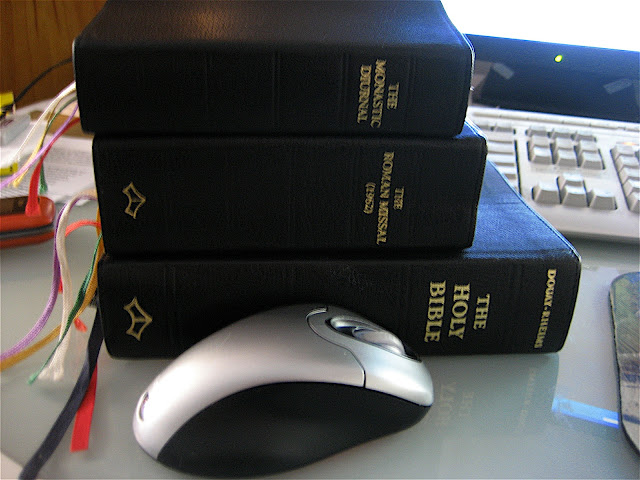
Since I have been comparing them to the Baronius books I will continue in that vain. Let's look at the size. It will be a great travel companion thats for sure. This will give you an idea:


As you can see, it is the smallest of the black leather-bound Catholic book family. It has become quickly apparent that nearly any Catholic book worth having for life is worth buying in a flexible leather cover. (Will someone get working on the Liber Usualis please?) But oh, what about the print of the book? Certainly something so small with such a vast amount of text would be difficult to read because the font would be so small right? Not so fast...


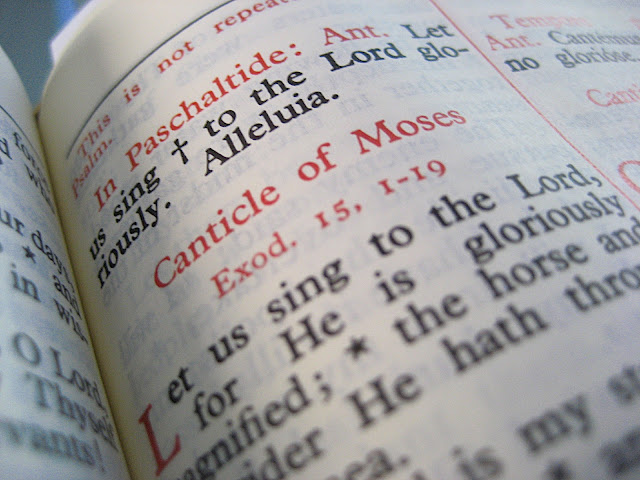
The text is clear as day. Everything is English/Latin parallel. Very readable and easy on the eyes. Once you are used to the Psalter set up (still getting the hang of it, but its coming...) it gets even easier. I'm even able to read along in low light because the font-weight is relatively heavy.

The English translation is not Douay-Rheims but a special translation it seems for this Diurnal. I have been able to compare the DR with the Diurnal English texts and I have to say the difference is negligible. For instance the Douay-Rheims Psalms will translate "iniquitatis" as "iniquities" where the Diurnal text will translate is as "sin". No matter to me, in fact I find it easier in some ways.


The monks of Farnborough Abbey have obviously created/provided this book out of a work of love for God and the laity. I think one of the best gifts they have given us is the Psalter as arranged by St. Benedict. And the Hymns, oh the Hymns! They are magnificent. I read a comment somewhere that many of these hymns are ancient and the original Latin has been retained. Imagine, by using this Diurnal we can unite ourselves to past Christians going back 1500 years. The same prayers, the same order. That is a great thought.

I'll leave this review with the message from the monks found on the final page of the Diurnal:


p.s. I am also looking forward to Baronius' Breviary.
"The whole truth is generally the ally of virtue; a half-truth is always the ally of some vice." - G.K. Chesterton