Showing posts with label eastern churches. Show all posts

Thursday, April 15, 2010

Non-Review: The Horologion (2 Edition) - Sophia Press

I dare not review this title, due to my general ignorance of the Eastern Divine Office. My review would be embarrassing and sometimes its best not to say anything. But I wanted to show at least the physicals of this beautiful book to you. This is the second edition. I used the first edition in a Melkite monastery once, and this one is of superior quality.


The Horologion (Sophia Press)


The cover isn't limp but it is sturdy and flexible.


Lays flat relatively well. Though as an Office book I don't see the need for it to do so. This is a sewn binding.


Strangely, the ribbons are clumped together. It is the same with the Publican's Prayer Book.


The spine of this beautiful book. In this photo you can really see how nice and thick the leather cover is. This cover feels the same as the Publican's Prayer Book. I'm not sure if it is a type of bonded or genuine leather. Still - its wonderful. Publishers should take note of this cover and copy it to the best of their ability.


An example of the modest but well done artwork in the Horologion.


The typesetting is excellent, and the wider margins with large text are extremely easy on the eyes.


Buy it from Sophia Press here.

Wednesday, March 17, 2010

Review: The Publicans Prayerbook

I recently purchased the Publican's Prayer book by Sophia Press. Sophia Press is the official publishing arm of the Melkite Greek Catholic Eparchy of Newton. They have two dozen or so books available about the Melkite and other eastern churches. Spurred by my recent visit to the local Melkite monastery and my general interest in the Christian East, I decided to look for a way to incorporate some eastern practices into my devotional life.

The leather on this volume feels near identical to that which can be found on the Harper NRSV XL. I believe the NRSV XL is bonded. I'm not sure if this is real or bonded. The cover smells real. But at any rate, it is a very nice, textured, soft leather cover. The gold stamping is well done. The book does not lay flat, but that's fine since this is a hand-held book. The Publican Prayer Book comes with five very slender ribbons.


The front and spine.


Back cover.

Morning prayers.


The Publicans Prayer book contains a section on daily prayers (morning through prayers before sleep), prayers for various needs, devotions for Communion, and examination of conscience, prayers before, during, and after Confession, a section for the Liturgical Year, Canons, Akathists (more on those in a minute), Church Father commentary on various subjects, a glossary of terms, and finally a section on Eastern Christian practices.


There is quite a bit between the covers and enough explanation in each section to help a Latin Rite Catholic like myself participate in the life of the East. One of the best things they added was the glossary of terms. I have to admit - I have no problem telling you what an Antiphon, a Canticle, or a Collect is but if you asked me what an Akathist, Kontakion, or a Metany was before using this prayer book I probably would have looked at you sideways. I had heard all these terms before but allowed them to go in one ear and out the other. The glossary should be longer however. As it stands there only a few terms defined. It would have been nice to have several more pages of eastern liturgical lingo.

There is a lot of artwork throughout the book. Not all of it is so well done however. Rather than finding high quality images to use of certain icons it appears they used small images and blew them up to fit on the page. Some of it looks like clip art on a poorly designed website.


Bad image.


And yet there are other images that are very well done.


There is only one prayer which might present a problem for some. In the prayers for various needs section there is a particularly beautiful prayer for aborted children. The prayer seems to assume that heaven is open for them and that is a highly debated subject in the Church. Personally I hold to the “limbo” theory and believe it to be an extremely generous one. However we do know God is not bound by his Sacraments. That said, G.K. Chesterton once warned that the ultimate tyranny is when the exception becomes the norm.


The Morning, Daytime, Evening, and Prayers Before Sleep will be your most used sections of the book. However the heart of the text in my opinion seem to be the Canons and devotions for Confession and Holy Communion. The prayers themselves are among some of the most beautiful I've ever seen in any prayer book.


At $35 I highly recommend adding this to your library. If any eastern Christians have anything to add here about any of the prayers included I welcome them in the comments section.


The binding and ribbons.


Buy it from Aquinas and More here.

Monday, March 15, 2010

(Preview) Publicans Prayer Book


I just received in the mail a copy of the Publicans Prayer Book published by Sophia Press. This Melkite Greek-Catholic prayerbook is outstanding. I can't wait to show it to you in detail.

Please excuse my quick cell phone picture.

.

Saturday, February 13, 2010

(Some) Orthodox views on the Catholic Church (?)

Over the past two weeks I have taken a greater interest in the Orthodox Churches. This was spurred by going a few weeks ago to a local Melkite Greek Catholic Monastery. Now, if you read my conversion "story" over on the right sidebar here you will note that there was a time when I didn't know whether to go East or West in the Catholic Church. I was very impressed with the Catholic East but ultimately settled for the Traditional Latin Mass. Since then reunion of the full East with the West has been a big prayer priority for me.

I bought a few "Orthodox" books to get the feel for them. They have a very rich spirituality to them which is very attractive and for the most part are compatible with the Catholic Faith. They depart only (as far as I can tell) by the histories of their authors.

All of this research and reading has spurred a great love in my heart for the Christian East. Yet I am feeling a little deflated by the whole thing. Reading the Catechism or listening to our apologists gives you the idea that we are within spitting distance of reunion. But I don't think that is really true, at least it may not be "humanly possible" without a serious and massive conversion.

In this post I am only going to focus on one area: Holy Orders. Let's take a look at an answer to a Q&A on the Orthodox Church in America's website. [My Emphasis and Comments]:

Concerning Roman Catholic orders: Within the OCA Roman Catholic clergy generally are received into the Orthodox Church through "vesting"; that is, they are not ordained anew. While there are some Orthodox Christians today who would not follow this practice, there is evidence that this was in fact the practice in Russia several centuries ago. [So in other words, Romans who convert are generally not re-ordained. But other Orthodox people believe they should be. The implications of this are huge for Orthodox Christians. Imagine if your parish got a convert priest. Half the congregation could leave if he wasn't re-ordained. They wouldn't believe he is a priest.] One must also keep in mind that the practice of the Orthodox Church on this issue has been subject to change from time to time and place to place, often depending on situations appropriate to the setting. [Do they know what a priest IS? Could you imagine if it was the practice of the Catholic Church to NOT conditionally ordain clergy from other confessions where a doubt regarding their orders existed...but only from time to time?!!]

Concerning the Eucharist: Many Orthodox Christians do view the Roman Catholic Eucharist as the Body and Blood of Christ; others today would not subscribe to this. [So is the doubt growing or shrinking?] The answer is linked to whether one believes that Roman Catholicism is "with grace" or "devoid of grace."

Concerning the "grace of the priesthood": This is partially answered in point 1 above. The answer to this is also intimately linked on whether the Orthodox view Roman Catholicism as a body that is "with grace" or "devoid of grace." [Read carefully here.] Some Orthodox would say that Roman Catholic priests do possess grace; others would say that they do not. And I have encountered still others who would say that, upon conversion to Orthodoxy, the Holy Spirit "heals all that is infirm," a phrase found in the prayers of ordination and other sacramental prayers of the Orthodox Church. [They seem to not have a clear idea of what makes a priest a priest. "Some" Orthodox believe a man can lose his priesthood if he falls away. So what happens if man awakes one day and doubts his faith and falls away. Later in the same day he believes again, but then falls away after dinner. Before going to bed he believes again. How many times in that day was he no longer a priest?] A thorough examination of this question would also require a preliminary discussion on the meaning of "grace," as the Orthodox definition of grace [At least they defined something, right?] is quite distinct from "grace" as defined in Roman Catholic circles.

Concerning sacramental absolution: Your question here is highly theoretical, inasmuch as one might ask why an Orthodox person would approach a Roman Catholic priest for confession and absolution in the first place. Again, a thorough discussion of this would necessarily involve a survey of the different understanding of Confession held by Roman Catholicism and the Orthodox Church. For example, does one confess to the priest, who personally has the "power" to offer absolution and forgiveness, or does one confess to Christ in the presence of the priest, with the priest proclaiming God's forgiveness at the conclusion. [This is theological double-talk. Both of these are within the Catholic viewpoint so I don't see the problem here. I have never heard a Catholic priest say "You are not confessing to Christ, only to me!" This is the type of misunderstanding that gets worked out in theological and ecumenical discussions. Or perhaps they could read one of our Catechisms....]

Concerning whether Roman Catholicism is considered a heresy: Orthodox Christianity in general would view certain aspects of Roman Catholic teaching as heretical. The filioque is the classic example of this, although the Vatican a few years ago has made this addition to the Nicene-Constantinopolitan Creed an option even, if I am not mistaken, for Latin Rite Catholics. [I believe he is mistaken, at least in a liturgical sense.] Most Byzantine Rite liturgical books I have seen of late either do not include the filioque or include it in brackets, indicating that it is optional. Orthodox Christianity also rejects [Rejects? Or maybe they just have a different view of the same mystery?] such teachings as the Immaculate Conception, purgatory, and other uniquely Roman Catholic doctrines.

Source for the article: http://www.oca.org/QA.asp?ID=200&SID=3


The article goes on from there, but I think the point is made. The OCA website gives a good example of just how confusing Orthodoxy is. I for one, would never want to belong to a Church that couldn't tell me who did and who did not have the "grace of the priesthood". That would be a spiritual nightmare.

Perhaps I've been unnecessarily harsh on the Orthodox. If I have, leave a comment and let's discuss.

Saturday, August 26, 2006

Light of the East Radio coming to EWTN

Word has it that Light of the East radio will be coming to EWTN Radio beginning this September. I have been a subscriber to this podcast for many months now and can tell you I enjoy it greatly.

Fr. Thomas Loya of Annunciation of the Mother of God Byzantine Catholic Parish is the host. Most recently, he appeared on EWTN Live with Fr. Mitch Pacwa to talk about the Theology of the Body. John Paul II's Theology of the Body is a topic of great mention on Light of the East. Oftentimes there are entire programs around the issue.

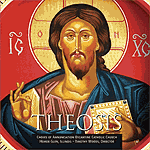
He also takes time to teach western rite Catholics about the riches of the eastern churches. I must say there is much to learn from this program and I highly recommend it. My copy of Theosis, the CD of their choir, is already on the way. :-)


Links:
Annunciation Byzantine Catholic Church
JPII - Theology of the Body
EWTN Live
"The whole truth is generally the ally of virtue; a half-truth is always the ally of some vice." - G.K. Chesterton